
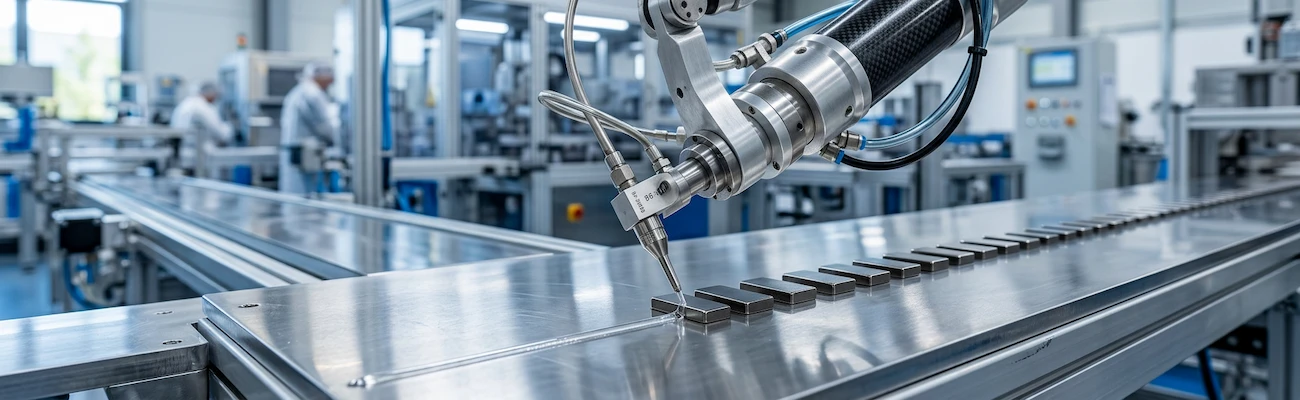
Fasteners hold. Bonding performs. Here's why the best motor assemblies rely on precision magnet-to-steel bonding—and what it takes to do it right.
Why Bonding—Not Fastening—Is the Right Answer for Precision Magnet Assemblies
In motors, linear drives, and precision motion systems, magnets don't just sit on a rotor or track—they define performance. Field geometry, torque consistency, positional accuracy, and mechanical reliability all depend on how precisely and reliably the magnets are integrated into the assembly.
Mechanical fasteners can hold a magnet in place, but they can't reliably control its position to the tolerances that motor performance demands. They introduce gaps, concentrate stress at contact points, and constrain the geometry around fastener placement rather than around the magnetic circuit.
Precision bonding changes that equation. When a permanent magnet is adhesively bonded to a steel backing structure, its position is set by the fixturing and adhesive system—not by the geometry of a bolt hole. The result is an assembly engineered for the loads it will actually see: static holding forces, dynamic vibration, and thermal cycling, with geometry optimized for motor or drive performance.
The Materials Involved and Why Each Presents Its Own Challenge
Permanent magnet-to-steel bonding covers a range of materials, each with different surface characteristics and bonding requirements:
Neodymium Iron Boron (NdFeB): The most common rare-earth magnet for high-performance applications. Typically nickel-plated, which requires adhesive chemistry specifically selected for compatibility with the plating—not the magnet material itself.
Samarium Cobalt (SmCo): High-temperature, high-coercivity rare-earth magnets often used in aerospace and defense applications. Excellent corrosion resistance, but surface preparation is critical to reliable adhesion.
Ceramic (Ferrite) Permanent Magnets: Lower cost and corrosion resistant, but brittle and sensitive to handling. Surface preparation and adhesive selection must account for surface energy characteristics different from rare-earth materials.
Alnico: High-temperature capability with lower coercivity. Used in specialized industrial and audio applications where thermal stability is the priority.
The steel backing structure adds another variable: surface condition, plating or coating, and thermal expansion behavior all affect long-term bond integrity. Getting adhesive selection right means evaluating the full material system, not just the magnet.
What Makes Magnet-to-Steel Bonding Technically Demanding
Several factors make this process more challenging than standard adhesive assembly:
- Strong magnetic attraction forces during assembly can pull magnets out of position during cure—fixturing must be designed to resist these forces while maintaining alignment
- Thermal expansion mismatch between the magnet, adhesive layer, and steel structure must be managed to prevent bond failure under thermal cycling
- Adhesive gap control is critical for rotor balance and positional accuracy—variations in bond line thickness translate directly to field geometry errors
- Static and dynamic mechanical loads in service require adhesives with appropriate shear strength and fatigue resistance
- Environmental exposure—humidity, chemical agents, temperature extremes—must be evaluated for long-term bond integrity, especially in defense and industrial applications
- High-volume production requires repeatable fixturing, dispensing, and cure processes that deliver consistent results across every assembly
Adhesive Selection: Matching Chemistry to the Application
There is no universal adhesive for permanent magnet-to-steel bonding. Selection depends on the structural and environmental demands of the specific application:
Epoxy structural adhesives: High bond strength and temperature resistance—the standard choice for demanding motor and drive applications where mechanical reliability is the priority.
Two-component epoxies: For maximum mechanical durability and fatigue resistance in applications with high dynamic loads.
Acrylic adhesives: Fast cure and efficient throughput where production volume is the primary constraint and structural loads are moderate.
Across all adhesive types, gap control is non-negotiable. Adhesive thickness variation affects rotor balance and magnetic field consistency—and in precision motion systems, those variations matter.
Applications: Where Magnet-to-Steel Bonding Is Used
Precision magnet bonding is the manufacturing method behind some of the most demanding assemblies in industrial and defense applications:
- Rotors: Magnets bonded directly to steel backing for consistent field geometry, mechanical retention, and rotor balance
- Linear motor magnet tracks: Precise magnet spacing and positional accuracy across the full track length—requiring consistent adhesive gaps and alignment from end to end
- Shaft-integrated magnet assemblies: Multi-segment magnet rings where geometry, balance, and positional accuracy directly affect drive performance
- Defense and aerospace actuation systems: High-reliability assemblies where bond integrity must be maintained across extreme environmental and mechanical conditions
From Prototype to Production: The Path That Matters
Allstar Magnetics engineers the bonding process with production volume in mind from the first prototype. That means validated cure parameters, documented work instructions, and repeatable fixturing systems are built into the process before volume manufacturing begins—not developed reactively after problems appear.
The transition from prototype validation to production is designed to be predictable, giving engineering teams a clear path from design lock to scalable manufacturing without process changes or quality surprises.
Validation and Reliability Testing at Allstar Includes
- Mechanical strength and shear testing
- Dimensional inspection and bond line verification
- Thermal cycling and environmental exposure testing
- Assembly alignment and positional accuracy verification
- Magnetic performance testing post-assembly
Need a magnet assembly that performs under real-world loads? Talk to Allstar Magnetics about your rotor, linear motor, or bonded magnet assembly requirements. Our engineering team supports material selection, fixture strategy, validation, and the path from prototype to production. You can move forward with greater confidence in performance, reliability, and manufacturability.
Allstar Magnetics is an AS9100, AS9120, and ISO 9001:2015 certified manufacturer of precision magnetic assemblies, ferrite core solutions, and permanent magnet products. ITAR registered.